
If you’re a night shift worker – first responder, healthcare worker, airline crew member – or someone who naps during daylight hours, standard curtains or light-filtering blinds usually won’t cut it. This guide explains why blackout blinds matter, which window treatments work best, and how to achieve total blackout so you can improve sleep quality, protect your health, and feel alert on the job.
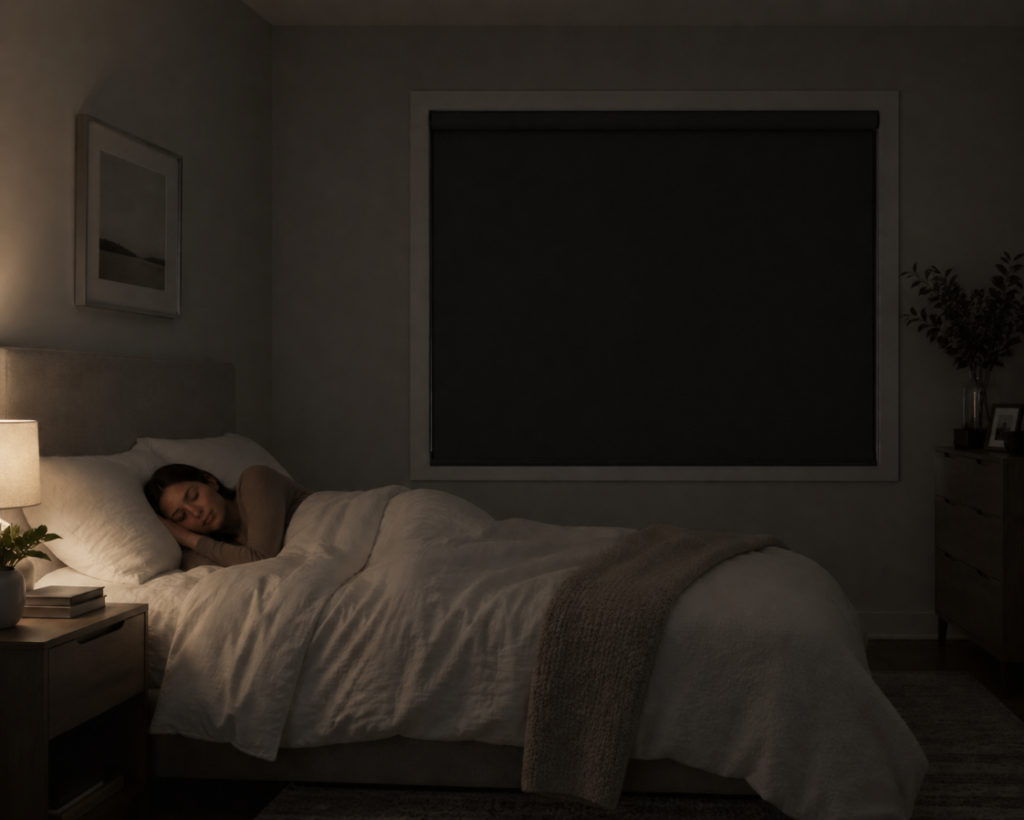
Why blackout blinds are essential for night shift workers
Night shift work is common—estimates put the share of workers on non‑standard schedules at roughly 15–20% in many developed countries—and the health costs of circadian disruption are well documented. In 2007 the International Agency for Research on Cancer (IARC) noted that long‑term night shift work involving circadian disruption is likely to have health risks; more recent research links poor daytime sleep to higher risks of metabolic problems, mood disturbance, and accidents on the job.
Light at the wrong time is the main culprit: even low levels of light during daytime sleep can suppress melatonin production and fragment sleep. That’s why effective window blinds and window coverings are not just a comfort item—they’re a workplace safety and health tool.
Quick fact: Light leakage—tiny gaps around the edges of a blind—can be enough to reduce sleep quality. “95% blackout” is often not enough; many shift workers need strategies to approach total blackout.
Which blackout window treatments work best?
Below are the most effective blackout blinds and solutions for daytime sleepers, with pros and cons and practical notes for night shift workers.
- Honeycomb (cellular) blackout shades
Why they’re good: Honeycomb or cellular shades combine blackout fabric with an insulating cellular structure. They reduce light, add thermal insulation (useful if you need to keep the room cool for daytime sleep), and help muffle outside noise.
Best for: Bedrooms where insulation and noise reduction matter. Choose a top-down/bottom-up option if you want flexibility.
- Cassette blackout roller blinds
Why they’re good: Blackout rollers have fabric that rolls into a slim cassette above the window so there’s less light at the headrail. Many are available in blackout fabrics and can be motorized.
Best for: Windows where you want a minimalist look and the best chance of full blackout; pair with side channels for near-total light blocking.
- Motorized and smart blackout blinds
Why they’re good: Automatic schedules let you lower blinds exactly when your shift ends and raise them before sunrise. App control and voice integration make it easier to maintain a consistent sleep environment (consistency is key for circadian health).
Best for: Shift workers who value convenience, those with irregular sleep schedules, or households where multiple people control blinds.
- Blackout curtains and layered solutions
Why they’re good: Heavy blackout curtains are effective when layered with blinds that have light gaps or if you prefer light filtering blinds for the daytime. A popular approach: honeycomb shades inside the frame paired with heavyweight blackout curtains outside for a thermal and light-blocking double layer.
Best for: Maximum light and noise control—especially for windows with odd shapes or when renting limits drilling or permanent fixtures.
- Total Blackout blinds
Why they’re good: Thanks to their bottom and side rails, Total Blackout Shades successfully block out 100% of unwanted light – no light gaps! They are designed to create maximum darkness for light sleepers at any time of the day.
Best for: Shift workers like healthcare workers, first responders, security agents, or airline crew, etc. They are ideal for anyone who works nights and needs to sleep odd hours.
Key concepts and common misconceptions
Light gaps are faulty products
Light gaps occur when a product is mounted inside the frame. It is not an error nor is it a defect. In order to prevent the blind from fraying against the side of the window frame, it must have a small gap. Otherwise, the material would get ruined quickly. To avoid light gaps and maximize darkness, we always recommend either an outside mount, layering with blackout drapes, or simply choosing our 100% total blackout blinds.
Why 95% blackout might still be too bright
A small amount of light—especially if it hits your face or bed—can be enough to interrupt REM sleep or shorten total sleep time for some people. Not everyone is as sensitive to light as others. While 95% blackout with minor light gaps can be perfect for many people, it can be tougher for sensitive sleepers or people who must get their rest during the brightest daylight hours.
How to choose the right blackout blinds: a practical checklist
- Measure carefully: inside mount vs outside mount changes coverage—outside mount with overlap (10–15 cm / 4–6 in) minimizes leaks.
- Choose Total Blackout Shades with bottom and side channels for full blackout — especially important for anyone trying to sleep midday.
- Choose insulating fabrics (honeycomb) if temperature control matters during daytime sleep.
- Consider motorized blinds if you need repeatable schedules or hands-free control.
- Layer for best results: blinds layered with blackout curtains is a stylish and elegant way to maximize light blockage without compromising on style.
- For renters: try Total Blackout blinds as they come with a No Drill headrail and can be easily removed. You don’t need to make any holes in the frames to install these effective blinds.
Installation & measuring tips
Small measurement or mounting errors magnify light leaks. Follow these steps:
- Decide inside vs outside mount. Inside mount looks cleaner but outside mount gives better blackout when you add overlap.
- Measure window width at top, middle, bottom—use the smallest measurement for inside mount. Add recommended overlap (manufacturer guidance varies).
- Always measure to the nearest 1/8” to ensure a perfect fit. Sizing is important to avoid huge gaps. If you make a mistake, don’t sweat it. Our Perfect Fit Guarantee means we’ll help you remeasure and will replace your blinds free of charge!
- Seal gaps with the foam tape provided with your Total Blackout shades for complete light blockage.
- Do not take deductions into consideration. The factory will make the necessary deductions so it’s important you don’t do this before. Otherwise, the blinds will have a large gap.
Noise, thermal comfort and insulation
Blackout blinds can do more than block light. Honeycomb shades trap air and reduce heat transfer, helping keep a bedroom cool—a key factor for daytime sleep. Heavy blackout curtains and cellular shades also muffle street noise, improving sleep continuity. You can also add a thermal liner to drapes and many of our blinds and shades for added insulataion.
Practical sleep hygiene tips for night shift workers
- Keep the sleeping environment cool (around 16–19°C / 60–67°F is often recommended) and dark.
- Use blackout blinds or covers consistently. Light exposure at odd times confuses circadian signals.
- Wear an eye mask when gaps remain—this is a cheap, portable backup.
- Limit blue light for 1–2 hours before sleep (phone, tablet, bright screens). Use warm lighting and/or blue-light filters.
- Use white noise or a fan to mask intermittent noises that can wake you.
- Keep a regular sleep schedule where possible; motorised blinds with schedules help maintain consistency.
Frequently asked questions
Are blackout blinds enough to restore healthy sleep for night shift workers?
They are a crucial component. Effective blackout blinds significantly improve sleep quality and melatonin production, but good sleep hygiene (timing, temperature, noise management) and regular schedule are also important. In some cases, consulting a sleep specialist is recommended.
Which is better: blackout curtains or blackout blinds?
Both help, but the layered approach is a great solution. If you are not interested in drapes and prefer complete blackout in one single product, then the Total Blackout Honeycombs or Rollers are perfect for your needs.
Ready to start sleeping better?
Ready to test how much better daytime sleep can feel? Start by blocking that first pesky light leak—measure your window and try an instant blackout cover or a honeycomb shade with overlap. If you’re ready for a long-term solution, Select Blinds Canada has got you covered.