Want sunlight on your ceiling and a private room at eye level? Top-down bottom-up shades let you have both. These versatile window coverings let you lower the shade from the top, raise it from the bottom, or combine both actions to control light, view and privacy exactly where you want it.
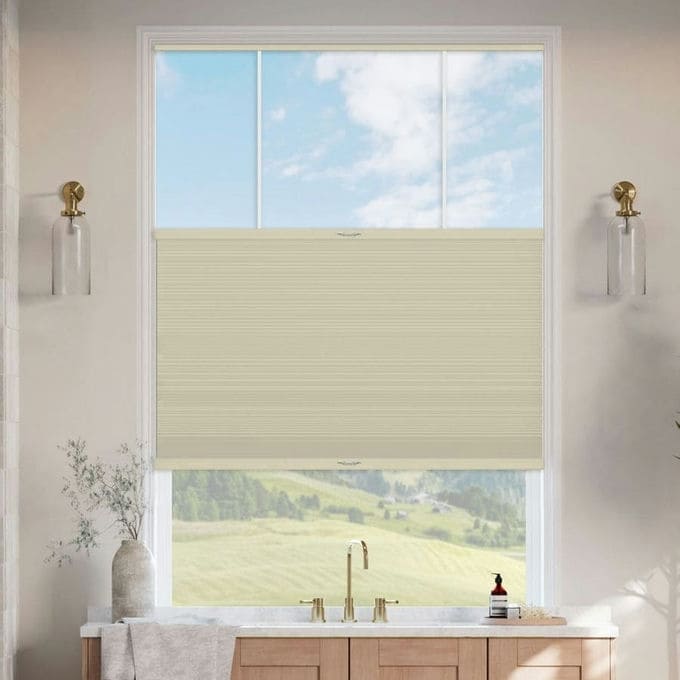

Why top-down bottom-up shades matter
Top-down bottom-up shades are a modern answer to a classic challenge: how to maximize natural light while maintaining privacy and comfort. Whether you’re shading a sun-soaked living room, keeping a bathroom private, or improving nursery safety, this lift configuration increases the useful options of almost any window treatment.
Key benefits at a glance
- Versatility — fine-tune natural light without fully closing window shades.
- Privacy — keep the bottom of the window covered while letting daylight in from the top.
- Improved light control — reduce glare without plunging a room into darkness.
- Insulating performance — cellular honeycomb and cellular shades add thermal pockets that help moderate heat loss and gain.
- Child and pet safety — cordless and motorized lift systems remove dangling cords, reducing risk.*
* Note: Motorization is only offered on Two-Fabric shades and is not currently compatible with Top-Down Bottom-Up Shades.
How top-down bottom-up shades work
Instead of a single bottom-up lift, these shades have two movable rails (top and bottom). You can lower the top rail to admit daylight at the top of the window, raise the bottom rail to reveal the lower glass, or position both rails to create an opening in the middle. The exact lift system varies by product:
- Cordless lift: Smooth, safe operation — recommended for homes with children and pets.
- Motorized lift: Battery- or hardwired motors for convenience and smart-home integration. (This feature is available on Two-Fabric shades only).
Materials and performance: which fabric should you choose?
Your selection depends on goals: light control, insulation, aesthetics or blackout performance.
- Cellular honeycomb (single vs. double cell): Best for insulating performance. Cellular shades trap air in pockets and can reduce heat loss and gain — manufacturers and energy resources report energy savings ranging from roughly 10–30% depending on window type and installation.
- Light filtering: Maintains natural light while softening glare — ideal for living room or family spaces where you want daylight without harsh sun.
- Blackout: For bedrooms, media rooms or daytime nurseries, blackout fabrics paired with TDBU let you keep privacy low while keeping the room dark.
- Two Fabric: This product is the best of both worlds because it combines light filtering fabric on top with blackout fabric on the bottom. This allows you to switch from one to another as needed. It’s important to mention that this particular model isn’t a traditional TDBU. It allows you to go up and down from one fabric to the other, but the top light filtering fabric does not come down as it would in a traditional TDBU shade.
Where to use them: ideal rooms and windows
Top-down bottom-up shades are useful almost anywhere, but they shine in specific applications:
- Living room: Let natural light brighten the space without exposing the seating area to street-level views.
- Bathroom: Maintain privacy at eye level while admitting soft daylight from the top.
- Bedrooms & nurseries: Combine blackout bottoms for sleep with top-down panels for morning light.
- First-floor windows and bay windows: Protect privacy from passersby while keeping daylight and view to the sky.
Common misconceptions
- “You lose insulation when you use the top-down option.” Not necessarily — many cellular honeycomb designs retain insulating value even when partially lowered because the cellular pockets still reduce direct heat flow.
- “TDBU requires complex installation.” Many TDBU shades install like standard shades and can also come with a no-drill option to simplify installation even more.
Measuring, mounting and lift system tips
- Decide inside vs outside mount: Inside mount gives a cleaner look; outside mount provides fuller coverage and better blackout performance. For precise light control at the top of the window, an inside mount often looks neater when the top rail sits flush beneath the window head.
- Measure carefully: Measure width at three points and use the smallest measurement for inside mounts; measure height from head to sill and allow clearance for the top and bottom rails.
- Choose the right lift system: Cordless or motorized options are recommended for homes with kids and pets. A continuous loop or corded system is no longer retailed anywhere in Canada due to new health and safety regulations.
- Match opacity to room use: Light filtering for living rooms and kitchens; blackout for bedrooms and media rooms.
- Think about energy and insulation: For drafty windows, opt for cellular honeycomb with a double-cell construction.
Maintenance and care
Regular care keeps window shades looking good and functioning smoothly:
- Vacuum gently with a brush attachment to remove dust.
- Spot-clean stains with manufacturer-approved cleaners; avoid soaking cellular fabrics.
- Check the lift system annually — tighten brackets, lubricate moving parts if recommended, and check motor batteries for motorized units.
- Keep pets’ claws and curious fingers away from the fabric to avoid tears.
Frequently Asked Questions
Are top-down bottom-up shades safe for homes with kids and pets?
Yes. Our cordless TDBU and motorized Two-Fabric shades, eliminate the need for dangling cords. Canadian retailers are only allowed to sell window coverings that do not have cords in order to respect health and safety guidelines. All of our products – across all categories – are fully compliant at Select Blinds Canada.
Do top-down bottom-up shades reduce energy bills?
Yes, they can because cellular honeycomb shades provide insulating air pockets. Combined with proper installation, you may see measurable reductions in heat loss and cooling gains.
Can I get blackout fabric in a TDBU shade?
Absolutely. We offer two-fabric (day/night) constructions or blackout bottoms so you can have both privacy and complete darkness when needed. You can click on our TDBU category and filter by “blackout” for a quicker shopping experience.
Is motorization worth the extra cost?
For large windows, high or hard-to-reach placements, or for smart-home integration, motorization is often worth the investment for convenience and safety. We recommend choosing motorization whenever it is available. However, some products are not compatible with motorization, like traditional TDBU shades.
Why are the current TDBU shades different from the ones I bought from you a few years ago?
Health Canada requires that window blinds sold in Canada be designed so that cords don’t pose a strangulation risk to children. This means long, loose cords are no longer allowed—especially ones that form loops or can be easily pulled down. Manufacturers must either use cordless designs or keep any accessible cords very short (generally under about 22 cm / 44 cm loop) so a child can’t get tangled in them. This came into effect May 1, 2022. That is why blinds you may have purchased before this date are different.
What should I do if I have the old, non-compliant TDBU shades?
There is no obligation to change your shades, however, we take Health Canada’s guidelines seriously. Your safety and the safety of those around you matters to us. We highly recommend you do update your shades to a safe and compliant product.